Relationships matter, and even strong relationships can become difficult when communication breaks down, conflict becomes repetitive, or people begin to feel unheard, disconnected or uncertain about how to move forward.
I provide a structured, compassionate space to understand what is happening between people and to work out what needs to change. My approach draws on Gottman Method Couples Therapy, alongside my broader background in trauma-informed psychotherapy, attachment-informed practice, nervous-system-informed approaches and integrative counselling.
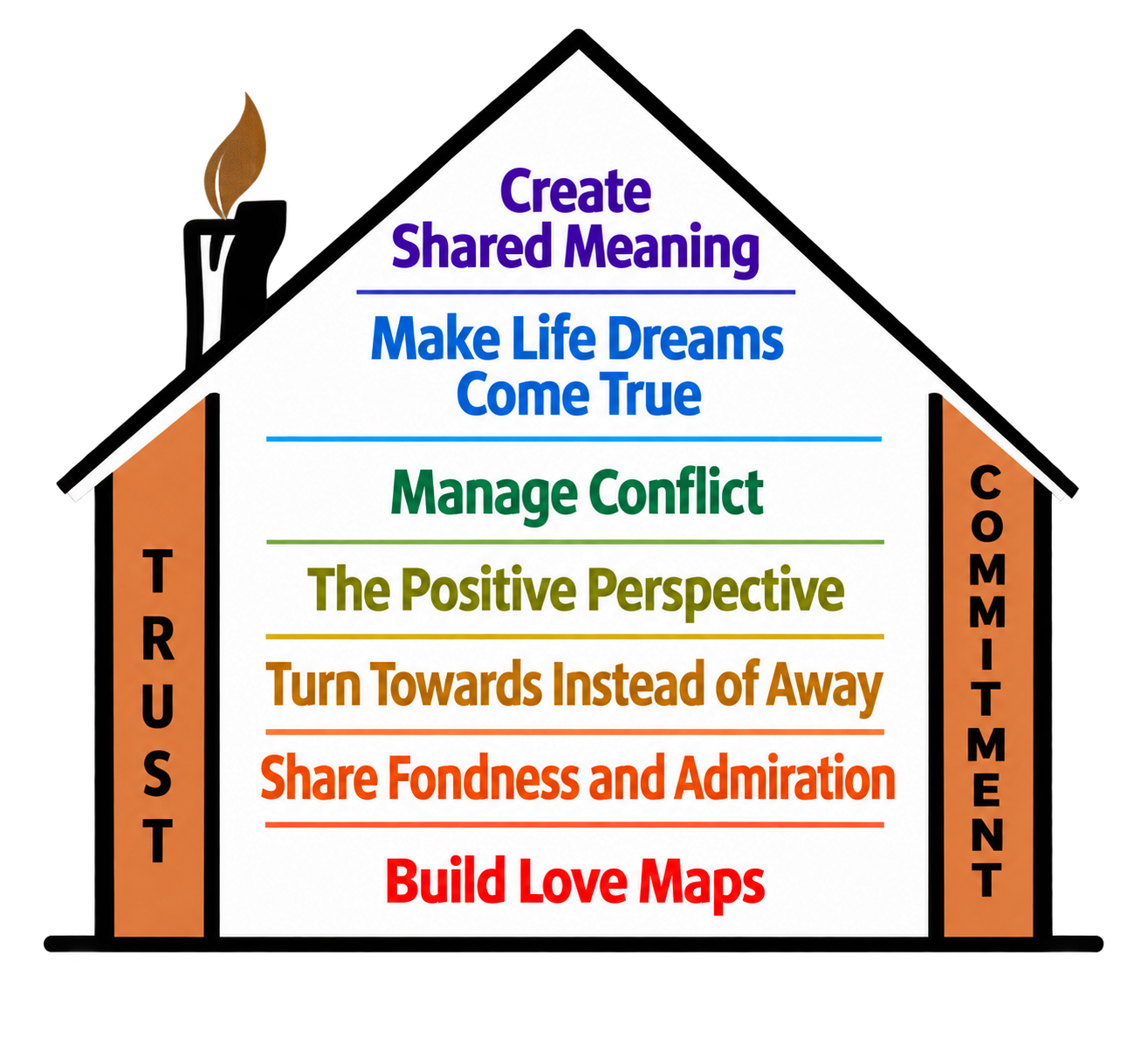
The Gottman framework provides a practical, research-informed map for understanding the patterns that can shape a relationship, including friendship, trust, communication, conflict, repair and shared meaning. I combine this with a broader psychotherapeutic perspective that considers the experiences each person brings into the relationship, including attachment patterns, stress responses and the ways the nervous system can influence how we communicate and respond to one another.
I don't take sides or decide who is “the problem”. The focus is on understanding the relational pattern, helping each person feel heard, and creating space for meaningful change.
How I approach relationship therapy
Relationships are shaped by patterns. Sometimes those patterns develop gradually through misunderstandings, unmet needs, stress and disconnection. At other times, earlier experiences, attachment patterns or prolonged stress can influence how people respond to one another in the present.
Rather than focusing on who is right or wrong, I work with couples to understand the cycle they have become caught in. This can create space to slow things down, recognise what is happening beneath the surface and develop different ways of communicating, responding and repairing.
My approach is collaborative and non-blaming. Each person brings their own experiences, needs and perspective to the relationship, and therapy provides a structured environment in which these can be understood without either person being reduced to a diagnosis or a problem to be fixed.
My broader clinical experience also matters. After more than two decades working across education, counselling, crisis support and psychotherapy. I bring maturity, calmness and perspective to difficult conversations, and I am comfortable sitting with strong emotions, and complexity and uncertainty without turning the session into a courtroom.
I also pay attention to what happens when people become overwhelmed. Conflict is not only verbal or cognitive; people can become psychologically activated, defensive, shut down or disconnected. My trauma-informed and nervous system-informed background helps me to recognise when regulation and safety need attention so that meaningful relationship work can actually take place.
The aim is not a perfect relationship. It is a relationship with greater understanding, trust, respect, connection and capacity for repair and practical skills that can continue to work long after the session ends.
Gottman Method Couples Therapy
Developed from decades of research into relationships, the Gottman Method offers a structured framework for understanding the factors that contribute to friendship, trust, communication, conflict, repair and shared meaning within couples.
One of its strengths is that it moves beyond simply teaching couples how to communicate better. It helps identify the patterns that can gradually erode connection, while developing practical ways to strengthen the relationship and respond differently when difficulties arise.
I have completed Gottman Method Couples Therapy Level 2 Training, building on the Level 1 foundation of the Gottman Method. My approach is to integrate Gottman-informed work within my broader psychotherapy approach, adapting the work to the people in front of me rather than treating the model as a rigid formula.
Frequently Asked Questions
Some common questions about relationship therapy and what you can expect from the process.
-
Relationship therapy can be helpful for couples, family members, business partners and others who are experiencing recurring conflict, communication difficulties, emotional disconnection, loss of trust, or uncertainty about how to move forward. It can also be useful when a relationship is generally strong but particular patterns have become difficult to shift.
The focus is on understanding the relationship and the patterns that develop between people, rather than deciding who is right or wrong or who is to blame.
-
No. Relationship therapy does not need to begin when a relationship has reached breaking point. Many people seek support when they notice recurring arguments, growing distance, communication difficulties or patterns that they have been unable to change on their own.
Starting earlier can provide an opportunity to understand these patterns and develop different ways of responding before difficulties become more entrenched.
-
It is not unusual for people to feel differently about starting therapy. One person may be ready to seek help while the other may feel uncertain, cautious or simply unsure about what to expect.
I provide a calm, non-judgemental environment where there is no expectation that either person will be blamed or required to take sides. The aim is to understand what is happening within the relationship and create a process in which both perspectives can be heard.
-
Yes. Relationship difficulties are not always best addressed with everyone in the room. Individual therapy can sometimes provide space to explore relationship patterns, communication difficulties, attachment experiences, boundaries, emotional responses or decisions about how to move forward.
Where appropriate, individual work can also complement relationship therapy.
-
I have completed Gottman Method Couples Therapy Level 2 Training, building on the Level 1 foundation of the Gottman Method.
The Gottman Method provides a structured, research-informed framework for understanding couples, including friendship, trust, communication, conflict, repair and shared meaning. I integrate Gottman-informed approaches with my broader background in psychotherapy, including attachment-informed, trauma-informed and nervous-system-informed practice.
I adapt the work to the people in front of me rather than treating any therapeutic model as a rigid formula.
-
Relationship therapy can provide a structured space to understand what has happened, how it has affected each person, and what is needed to determine a constructive way forward.
Rebuilding trust is often a process rather than a single conversation. Depending on the circumstances, therapy may focus on honest communication, understanding the impact of the rupture, accountability, boundaries, emotional safety and developing the capacity for repair.
The aim is not to force a particular outcome, but to create a space where the relationship can be understood more clearly and meaningful decisions can be made.
-
The first session provides an opportunity to understand what has brought you to therapy, hear each person's perspective and begin identifying the patterns that may be affecting the relationship.
Where appropriate, I may also introduce Gottman relationship assessments to help develop a more detailed understanding of the relationship, including its strengths, areas of difficulty and patterns of interaction. These assessments can provide a useful starting point for shaping the therapeutic work around your particular relationship.
We will discuss what you would like to change and consider what may be helpful moving forward. I will explain how I work and, where appropriate, introduce relevant Gottman-informed or broader therapeutic approaches.
You do not need to arrive with everything worked out. The first session is a starting point for understanding what is happening and developing a clear direction for the work ahead.
-
Relationship therapy is available in Cairns and Kuranda by appointment, with Telehealth also available.
Sessions are provided in a private, confidential and supportive environment. If you are unsure whether relationship therapy is the right fit for your situation, you are welcome to get in touch to discuss your circumstances and the type of support you are looking for.